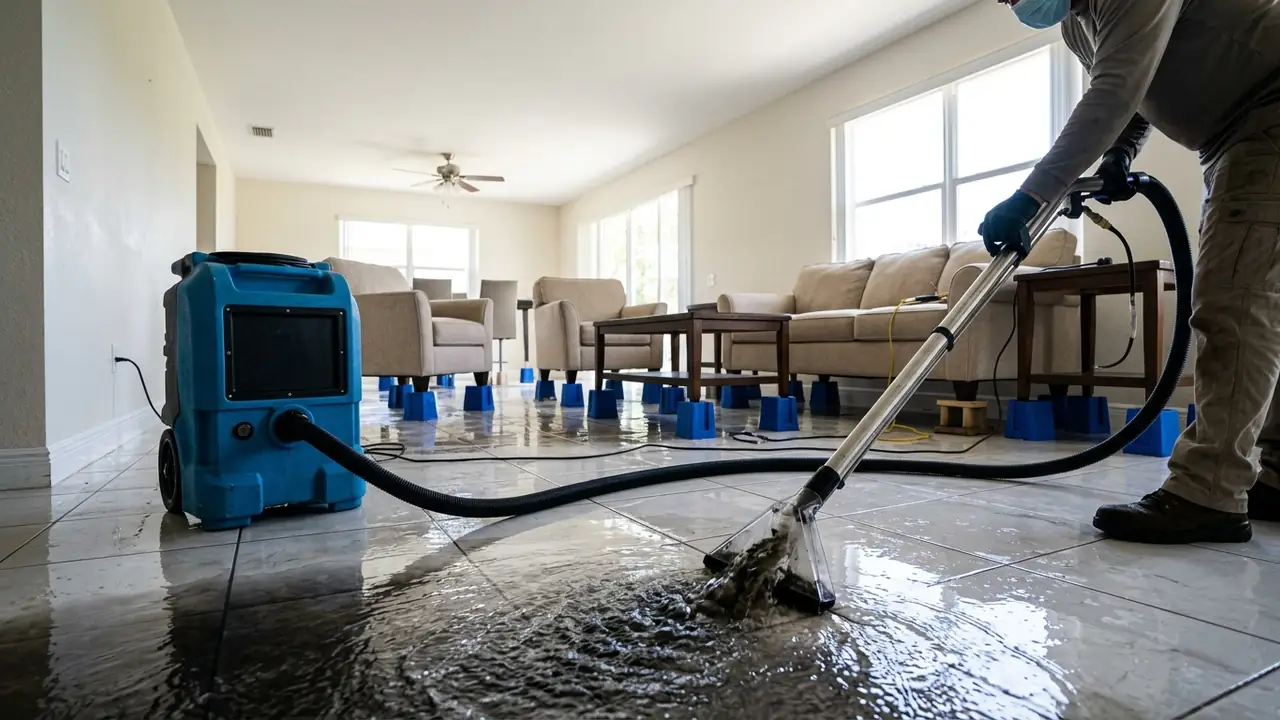
You can usually handle a small, clean-water spill on tile yourself with towels, a squeegee and a wet/dry vac, as long as you start quickly and the water hasn't spread under flooring or into walls. Call for professional emergency water extraction if the water is from sewage or outside flooding, covers more than one room, has soaked carpet and pad, or sat for more than a few hours. In Tamiami's humid climate, mold can start on wet materials within 24 to 48 hours.
Safety first: when not to touch the water
Before you grab a towel or a vac, check three things. If any of them apply, stay out of the water and call for help.
- Electricity. Water near outlets, power strips, appliances or the electrical panel is a shock risk. Only switch off breakers if you can reach the panel from a dry spot.
- Contamination. Water from a toilet backup, sewer line or outside flooding is Category 3 (black water) under the IICRC S500 standard. It can carry bacteria and chemicals, so it isn't a DIY job.
- Structure. A sagging ceiling, bulging drywall or water coming through light fixtures means water is trapped above you. Keep people out of the room.
If you smell gas, leave the house and call 911 or your gas utility from outside.
DIY or professional? A quick decision table
The question isn't only how much water you can see. It's where the water went and how long it has been there.
| Situation | Usually OK to handle yourself? | Why |
|---|---|---|
| Small clean-water spill on tile or terrazzo, found right away | Yes | Water stays on the surface and is easy to remove |
| Overflowing sink or tub, water stayed in one room | Often yes | Check baseboards and the room below or next door |
| Washing machine or dishwasher overflow | Maybe | Gray water (Category 2); clean and disinfect, watch the cabinets |
| Water soaked carpet and pad | No | Household vacs can't pull water out of the pad |
| Water under laminate, vinyl plank or wood floors | No | Trapped water needs extraction and moisture readings |
| Water spread to several rooms or into walls | No | Hidden moisture needs meters and drying equipment |
| Sewage, toilet backflow or outside floodwater | No | Category 3 water needs protective gear and sanitizing |
| Water sat for many hours or overnight | No | It has had time to wick into drywall and cabinets |
How to remove a small amount of clean water yourself
For a small clean-water spill that you found quickly, this order works well:
- Stop the source. Close the valve under the sink or toilet, or turn off the main shut-off.
- Take photos. A few wide shots and close-ups before cleanup help if you decide to file a claim later.
- Push water toward one spot. On tile, a floor squeegee moves water faster than towels. Push it toward a floor drain, a shower or one corner.
- Use a wet/dry vac, not a household vacuum. Empty the tank often. A regular vacuum isn't built for water and can be a shock hazard.
- Blot what's left. Towels or a mop for the last film of water, then wring them out outside the wet area.
- Lift and open. Move rugs and furniture, put foil under furniture legs, and open cabinet doors and drawers so air reaches inside.
- Dry the air. Keep windows closed and your AC running at a normal setting. Run a dehumidifier and fans if you have them. Outdoor air in Miami-Dade is usually too humid to help.
- Check again the next day. Press on baseboards, look at the bottom of drywall and smell the room. Soft, swollen or musty means water is still there.
What to expect by floor type
Most Tamiami homes are concrete block on a concrete slab, so the floor covering decides how hard the water is to get out.
- Tile and terrazzo. These handle water well. The risk is water in grout lines, under loose or hollow-sounding tiles, and in the baseboards and drywall next to the floor.
- Carpet. The pad underneath holds much more water than the carpet itself. Pad usually needs professional extraction, and after gray or black water it's normally replaced. See wet carpet and flooring drying.
- Laminate and vinyl plank. Water slips through the seams and gets trapped on the slab underneath, where it can't evaporate. Planks often have to be lifted.
- Engineered or solid wood. Wood swells and cups as it absorbs water. Fast extraction and controlled drying give it the best chance.
Signs water is hiding where you can't see it
A dry-looking floor doesn't always mean a dry house. Watch for these in the days after a leak:
- Baseboards that feel soft, swollen or are pulling away from the wall
- Paint bubbling or a darker band at the bottom of drywall
- Floor planks that cup, lift at the edges or feel spongy
- A musty smell that comes back after cleaning
- Cabinet toe-kicks or the bottom of a vanity that look stained or swollen
- Water stains on the ceiling of the room below, in a condo or two-story home
If you notice any of these, the water has moved past what household tools can reach. Our structural drying page explains how moisture readings and drying equipment deal with it.
What professional extraction adds
The main difference is equipment and measurement. Pulling liquid water out mechanically is much faster than waiting for it to evaporate, so the more water that comes out at the start, the shorter and cheaper the drying usually is.
| Task | Household tools | Professional equipment |
|---|---|---|
| Standing water | Wet/dry vac, buckets, towels | Submersible pumps and truck-mounted or portable extractors |
| Carpet and pad | Surface water only | Weighted or ride-on extraction tools that press water out of the pad |
| Finding hidden water | Touch, smell and looking | Moisture meters and thermal imaging |
| Drying | Box fans, AC, a home dehumidifier | Air movers and commercial dehumidifiers with daily readings |
| Records for insurance | Your own photos | Moisture logs, photos and a written scope |
To see how a full job works in Tamiami, read about emergency water extraction. If the water is from a sewer line or outside flooding, see sewage cleanup or flood damage restoration.
Mistakes that make water damage worse
- Using a regular household vacuum on wet floors.
- Opening windows to "air it out" on a humid day.
- Turning on ceiling fans or lights in a room with a wet, sagging ceiling.
- Leaving wet rugs or carpet pad in place and hoping they dry.
- Painting, caulking or putting baseboards back before the walls are confirmed dry.
- Throwing away damaged items before photographing them.
Water spreading or already in the walls? Call (833) 361-6767 for fast service in Tamiami.
Frequently asked questions
Can I use a shop vac to remove water from carpet?
A wet/dry shop vac can pull surface water out of carpet, but it can't get much out of the pad underneath. If the pad is soaked, it usually needs professional extraction or replacement.
How do I know if water got under my tile or laminate?
Look for hollow-sounding or loose tiles, planks that cup or lift at the seams, and baseboards that are soft or swollen. A moisture meter gives a reliable answer.
Should I run my AC after a water leak?
Yes, at a normal setting, because it helps remove humidity. Turn it off and have it checked only if the air handler, ducts or return were flooded or contaminated.
How long can water sit before it causes mold?
The EPA recommends drying wet materials within 24 to 48 hours to prevent mold growth. In warm, humid South Florida, it's best to start right away.
Is a washing machine overflow safe to clean up myself?
Washing machine water is gray water (Category 2). A small overflow on tile can often be cleaned and disinfected by the homeowner. If it soaked carpet, cabinets or drywall, get professional help.
More water damage guides
- Water Damage in Your Home: What to Do in the First 24 Hours
- Water Damage Categories and Classes, Explained Simply
- How Long Does Water Damage Restoration Take?
- Filing a Water Damage Insurance Claim in Florida: A Homeowner's Guide
Related services: Emergency Water Extraction · Structural Drying & Dehumidification · Wet Carpet & Flooring Drying · Water damage restoration in Tamiami